
WILD WAFFLE
solo creator
Inktober 2026
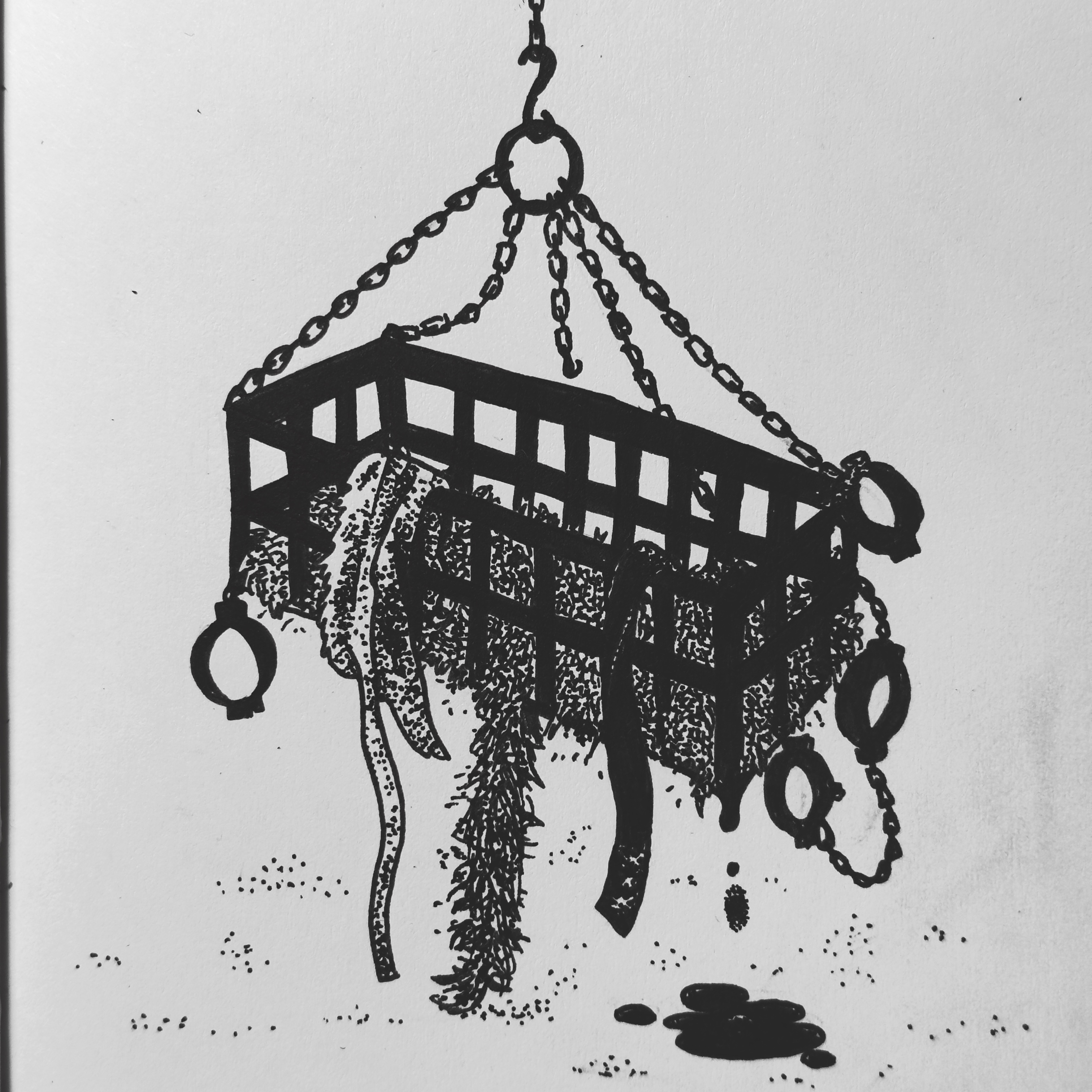
Inktober 2026 is done, and it’s the second year in a row I’ve finished all thirty-one days. This year’s story is called Under the Altar: the diary of a young novice who arrives at a remote island convent and, one small detail at a time, starts to understand where she has ended up. It is a horror story, but a quiet one. Nothing in it raises its voice.
Last year’s story grew by accident, drawing by drawing. This time I planned everything before the first dot: the arc, the lore, the diary entry for every day, and which object from the official prompt list would carry it. Apple, relic, cactus, ram, trophy, tusk. Each prompt became a thing in the convent that the narrator cleans, carries, hides or is handed. The story is told only through those objects and her short entries, written in a calm, polite, grateful voice, even when she has every reason not to be.
Each day started with a reference image of the object, staged like a photograph from a case file against plain white. I generated those with an AI image tool, then redrew every one by hand as stippling: thousands of tiny dots, dense in the shadows and dissolving toward the white. I drew mostly in the mornings, sometimes at lunch, one drawing a day. The technique gave the whole series a dry, smoky, slightly sterile atmosphere that I couldn’t have found any other way.
I wrote the entries in Russian and translated them into English, so the book contains both versions. All thirty-one drawings and entries are collected in the attached PDF, in order. Content note: the story contains violence, psychological cruelty, captivity and bodily harm. Please read it with care.
City 410
“CITY 410” is a five-episode mockumentary about a city that was never on any map. Each episode starts as an ordinary vlog: a morning in the metro, a conversation about small dreams, a tour of what I carry every day, a morning that follows its usual script, a walk through autumn. Somewhere inside those ordinary hours something is wrong, and the series follows it one layer at a time.
It is filmed in Ryazan, in Russian, and the English subtitles are part of the look. Every episode also contains a podcast-style layer built around one idea, and those ideas had been sitting in my notes since last autumn. The picture has a worn VHS texture and visual effects where the story needs them. Some shots contain digitally altered footage: I used generative AI tools for the effects and Claude as orchestrator. The full list is at the bottom of this post.
I planned the series for more than a year. I shot it on weekends and evenings, edited it on weekday mornings and released it week by week through October 2026. All five episodes are in the playlist below. Watch them in order.
If you have not seen it yet, stop here. The block below is spoilers, together with my favorite stories about how the series was made.
SPOILER ALERT
The story. The fictional city exists, under real Russian city - Ryazan. It was emptied after an epidemic called the Hunger, followed by a quarantine and an evacuation. The narrator is a vlogger who slowly works out that he was born down there, that he had a twin brother, and that he was carried out of the city as a baby. The number in the title is actually an easter egg and has a refernce to bible and http.
The layers. Episode 1 is a metro vlog and a cassette from Grandma’s cupboard. Episode 2 is about dreaming small and a strange thread on a local forum, with a quiet subplot about ventilation structures. Episode 3 starts with everyday carry and slides into the lore through a photo found in a cassette case: a man named A. Vedernikov, “Last shift”, Aug. 1997. By episode 5 you can work out that this was the shift when a baby left the city. Episode 4 is a morning that follows the usual script, a phone call that ends too early and a door found in a dream. Its podcast section is about keeping some magic alive by not knowing everything. Episode 5 goes underground.
The bible. Before shooting I wrote a production bible: nine sheets with episode breakdowns, a continuity tracker for every object that travels through the series, a sheet on who knows what, and one I called “viewer knowledge” that tracks how much the audience knows at each step. It let me check the dosage of information minute by minute.
What got cut. Episode 4 lost a planned scene with a grandmother and an envelope. Episode 5 lost its paper documents. A phone call, a door and one long monologue, delivered while the phone battery runs out, took their place. A sign that read “ГЭС-1” (a hydroelectric station) became “ТП-1” (a traction substation), because that is where an electrician from the transport hub would have worked.
The effects. The underground city, the door and the brother were built with AI image and video tools, then matched back onto the original footage pixel by pixel. The city started as stills made with NanoBanana. The door-opening shot, the brother’s transformation and the black eyes were video-to-video work in Seedance and Kling. The usual problems: a cavern ceiling the model read as an object seen from outside, blown-out backgrounds, perspective drifting between edits, Cyrillic lettering that came out wrong. The cure was boring: change one thing at a time and lock the framing. The brother went through several designs, among them insect-like limbs, pure black skin and a body made of living cloth. The one rule from day one was no werewolf hands.
The ending. The finale begins with a vlog I never managed to finish, about why we love autumn. It ends on the same thought starting over and breaking off in the middle of a word.
Tools and AI:
- Visual effects: NanoBanana Pro, Seedance 2.5 and Kling O1. Always composited back onto footage I shot myself. Episodes with altered footage carry YouTube’s altered-content label.
- Sound design and music: Suno v6 and Suno v6-wild.
- Claude Opus (by Anthropic): my story consultant and sounding board. We brainstormed podcast themes, stress-tested plot changes and continuity, adapted my Russian scripts into English subtitles and refined prompts for the image and video tools.
- I wrote the scripts, shot the footage and edited the series all by myself.
Tres
TRES is the final part of the trilogy, and this time I decided to drop the voice-over completely. I wrote the track myself and then processed it through an AI model, so the music became the narration. For me, the whole trilogy ended up being about something pretty simple: sometimes you have to stay home to find the biggest adventures. And sometimes the biggest adventures only matter because they bring you back home and make you see it differently.
A lot changed in my life this year. I moved. I changed a lot of plans for the future, my priorities, my lifestyle. I changed the main way I move around the city, and because of that I started seeing the place where I live differently too. I used to be genuinely annoyed that we live on a plain. I would always say: “Give me mountains!” Now I look at long flat streets and country roads and think: “Oh yeah!.. These are perfect for my road bike.”
So I guess I learned to love this place in a different way. I’m going to live here for a long long time. And all my Dragons were probably in my head anyway. And if they start fucking with me again, I’ll kill every single one of them.
Duo
DUO is out - part two of the trilogy. I changed the plan for this video a few times. First I wanted to make a big trip in spring, then ride 100 kilometers closer to home. Neither of those happened. But instead, I ended up in Saint Petersburg and decided to ride 100 miles to Vyborg. The forecast looked easy, but in reality, it rained all day, there was strong wind, slippery roads and a lot of time to wonder why I was even doing this.
The strange part is that I had already written the whole Dragon lore before the trip - the road talking to you, trying to make you turn back. Somewhere in the middle of the ride, I actually started talking out loud to myself, the road and the wind. So yeah. The metaphor became too real for me. I made it to Vyborg. I defeated the Dragon I’ve created for no real reason.
One last part left to film. And TRES was already going to be different…
Unus
A new video is out. UNUS is the first part of a three-film series I started planning back in early spring. Most of this one was shot in May, before I really knew what the whole thing would eventually become. On its own, it’s pretty quiet, vague and probably a little confusing.
The story gets clearer in the next two parts, so I think the trilogy will probably work best watched back to back once all three are out. For now, this is where it begins.
Checkpoint
A small life update.
LUTs are here

Just added my own LUT pack to the Resources section of the site. It’s a small set of looks I built for my own edits — one clean Apple Log → Rec.709 conversion and a few simple styles for different moods: warm contrast, muted tones, a strong black-and-white look, and a cooler cinematic grade. Nothing fancy, just practical LUTs that are easy to drop into a timeline and start from.
You can grab them here:
Little bastard
I grew up and maybe not in a good way. I tried to remember what I was thinking about 10 years ago, when I was still a teenager and thought of myself as a punk. It’s strange how everything I spent so long running from eventually caught up with me, and I turned into boring adult. This video is more like a reminder to myself to remember who I really am.
E-readers
When an e-reader enters everyday life, what changes is not so much one’s relationship to literature as the architecture of the day itself. The text no longer waits for evening, for a lamp, for silence. It sits in your pocket, lightly dormant, ready to wake at a touch. The pause between “I should read” and “I am reading” disappears-and with it, the friction that once made the act deliberate. Reading stops being an event and becomes a reflex, almost a tic.
A paper book is different, and in its way, more honest. It has weight, texture, the faint smell of ink and glue. It requires light-a desk lamp or at least the mercy of daylight. To read it, you must carve out space, settle into a chair, detach yourself from the surrounding noise. There is a discipline in that inconvenience. A printed book resembles a traditional cigarette: to smoke, you step outside, feel the air, separate yourself from the flow of the day. It is an act that asks for a decision.
The e-reader operates by another logic, closer to the disposable vape. It is self-lit, self-contained, indifferent to setting. You do not have to step “into reading” or arrange a proper atmosphere. You can open a page in an elevator, on a train, in bed before sleep, in the kitchen between tasks. A brief impulse-and then back again. Dozens of such impulses accumulate over the course of a day. Reading detaches itself from time; it disperses into the margins.
The same principle has governed nicotine. Once the cigarette gave way to a device that required neither flame nor open air, consumption became nearly continuous. No longer a handful of clearly defined cigarettes, but countless small inhales, often unnoticed. Boundaries dissolved, and with them any sense of measure. Nicotine ceased to be an event and became a background condition.
It is not especially controversial to criticize electronic cigarettes for this. Convenience amplifies dependence. They erase edges, encourage frequency, transform a habit into a near-constant reflex. What presents itself as freedom is often just friction removed-and consumption intensified. But intellectual honesty demands consistency. Something similar happens with reading when it becomes frictionless. When the book is always with you, when it requires no light, no quiet, no decision-when text is available at every idle second-literature risks turning into a form of continuous intake. Five minutes here, ten there, and soon the day is saturated with pages the way it once might have been saturated with smoke. Reading becomes automatic, another strategy for filling the gaps, another way to avoid stillness.
We are conditioned to regard reading as an unqualified good, inherently elevating. But constancy is not the same as virtue. Uninterrupted reading, like uninterrupted nicotine, can dull the palate. Text becomes ambient. It regulates mood, occupies silence, smooths over discomfort. Convenience disguises compulsion. There was, perhaps, a quiet value in the limits imposed by older forms. A few cigarettes a day-bounded by weather, by space, by social constraint. An evening with a printed book under a lamp-bounded by light, by fatigue, by the natural arc of attention. Those constraints created shape; shape created measure.
Now we risk cultivating a generation of perpetual “readers,” consuming pages as mechanically as flavored vapor-rarely lingering, rarely digesting, rarely allowing the text to settle. In our effort to make everything accessible, we have made everything continuous.
Not all accessibility is benign. And it may be that a rare cigarette in the cold air, and a single deliberate evening with a paper book, preserve more clarity-and more silence-than a life spent in endless drags and endless pages.
Snowline
My last 21-st video in 2025. Some key results and reflection on what was happened during this year. I added some bloopers and tech roll in the end of the video.
I wish you a Happy New Year 2026! See you in January.
The Final Platform
Prebionist
I consider the mockumentary genre one of the coolest. I’d actually love to shoot a lot more in that spirit. From a technical standpoint, this one was an interview, and honestly, editing interviews afterward is the most boring thing I’ve done in my videos. So if I ever make fake documentaries again, I’ll choose a different format.
You can be anything you want
Inktober 2025
Oh yeah! I finally did it! I completed Inktober all the way to the end. Part of my motivation was also knowing that I’d talk about it later in a video. But there’s nothing wrong with one form of creativity pushing another one forward, right?
I also prepared a PDF where I collected all the illustrations from this month and the story I tell through the captions.
Scent
Boo! Did I scare you? I really love Halloween and everything around it. It’s just a shame that no one around me really celebrates it. Anyway, I wanted to convey a spooky, mystical atmosphere and at the same time share something personal. This is actually a toy from my childhood that was brought to me from IKEA. And I really did sleep with it throughout my entire childhood. And right noow it’s sitting on a shelf in my room, watching me write this post.
Trust
I don’t want to be some kind of life coach or talk on my channel about planning or how to organize your life. But I decided to test a new location and a new format using this kind of material. Now the only thing left is to actually follow these rules myself and trust my innie.
I'm not okay
I experimented with liminal spaces. It was fun walking around at night and looking for angles where neither cars nor people got into the frame. Just in case — I’m actually fine, I’m just making art, lol.
Getting burned
I always have fun with the actual filming process. Running around the city like I’m very important, with a tripod, filming myself with a mug of coffee (there was no coffee in the mug actually — and where I actually drink something, I always use cola). Anyway, during the last warm days I managed to shoot this kind of short film with a meaning. I honestly like it myself.
Surface
Last days of warmth
I came back from vacation and decided to shoot something short, just to test new approaches to filming.
The last Waterline
Waterlines
Since late autumn 2024, I’ve been running a YouTube channel. I started posting something like a monthly video journal, where I would share what happened to me over the month, reflect on it, and set goals. I called these videos “Waterlines” - for me, they were a kind of “water level check,” a chance to step back and look at my life from the outside. Honestly, I was scared to start, and I still feel nervous in front of the camera. It’s not easy to just open up and talk about something personal. But I tried.
Not every video turned out to be meaningful. I often repeated the same thoughts and didn’t always achieve the goals I set for myself. But the process itself allowed me to grow. That’s why, in August, I filmed my last Waterline. I’m ready to keep reflecting without these videos, ready to keep growing as a creator, and I’ve reserved YouTube now for content that feels far more valuable.
Fast
The video “Fast” was, of course, inspired by GAWX’s style. I tried, for the first time, to shoot something more intentional, with voice-over narration and complex, fast-paced editing. It was genuinely fun — fun to shoot, fun to edit, and fun to watch afterward. When I finished this video, I started to wonder: could I keep doing editing this complex all the time? Probably not. As cool as it is, I’m not GAWX. And I need to have my own style.